
Restaurant Supply Chain Management Software: What the Best Chains Are Doing Differently
E-BOOK | Sightline OS | 2026
The gap between best-in-class and average restaurant supply chain performance is measurable, meaningful, and widening. Here's exactly what's driving it — and what it takes to be on the right side of it
INTRODUCTION
Who This Report Is For — And Why It Matters Now
If you manage supply chain for a multi-unit restaurant brand — whether you're running 30 locations or 3,000 — this is for you.
We wrote it because 2026 is a pivotal year for restaurant supply chains specifically. The macro forces that have been building for years — inflation, commodity volatility, distributor consolidation, the accelerating shift to AI-driven forecasting, mounting pressure on COGS — are no longer on the horizon. They are here, and they are separating the chains that invested early from those that didn't.
The gap between best-in-class supply chain operators and everyone else is measurable, meaningful, and growing. The teams at the top are having fundamentally different conversations with their corporate teams, their operators, and their supplier/distributor partners. They are spending less time fighting fires and more time building competitive advantage. And increasingly, they are doing it with better data, better forecasting tools, and a clearer picture of what's coming.
This report is designed to help you understand where the industry stands today, what forces are reshaping it, and what the highest-performing teams are doing differently. It is a look at the state of restaurant supply chains — the gaps, the opportunities, and the practical steps that separate leaders from laggards.
The teams winning in 2026 aren't just reacting faster. They've changed the game entirely — from reactive to proactive.
How to Use This Report
Read it cover to cover for a comprehensive picture of where the industry stands and where it's going. Or use the section headers to navigate directly to the challenges most relevant to your team. Each section ends with a practical takeaway you can bring into your next leadership conversation.
A Note on Methodology
The insights in this report draw on Sightline OS’ work with restaurant chains across the full-service, quick-service, and fast-casual segments, as well as publicly available industry data, earnings call transcripts, and supply chain benchmarking studies. Where we reference specific case studies — including Din Tai Fung — we do so with permission and gratitude.
SECTION 1
Current State: Where Restaurant Supply Chains Stand Today
Before we talk about where supply chains are going, it's worth being honest about where most of them are right now. Because the gap between how supply chain teams spend their time and how they want to spend it is not a small one.
The disconnect starts at the top, and it's not just a perception problem — it's a bandwidth problem. A recent EY survey of 347 C-suite and supply chain executives found that 88% of C-suite leaders still view supply chain primarily as a cost center to be managed, not a growth lever to be pulled. That view isn't unfounded — it's a reasonable read of what they're actually seeing. Supply chain teams spend the bulk of their time firefighting problems that have already happened: chasing exceptions, managing distributor escalations, rebuilding reports that broke overnight. There's little time left over for the forward-looking work — scenario planning, demand sensing, proactive sourcing — that would let them show up with strategic recommendations instead of status updates.
The reason so many teams stay stuck in that reactive posture isn't a lack of ambition. It's a lack of visibility. EY's research found that 93% of organizations investing in AI for supply chain have not completed implementation — still stuck in planning, piloting, or paused mid-project. Without AI-driven forecasting and monitoring in place, teams are running on legacy systems that surface problems after they've already hit the business, not before. They're making decisions with yesterday's picture of the world, not tomorrow's. And when your systems only tell you what already went wrong, "managing the cost center" is the only conversation you have time to have.
That's the real gap this report is about — not a lack of data, but a lack of the forward-looking data and tools that turn supply chain from a reactive function into a strategic one.
-
Ask any restaurant supply chain director how they spend their week, and the answer is usually some version of the same story: chasing exceptions, responding to DC alerts, managing distributor escalations, fielding calls from operations, and trying to rebuild reporting that broke when someone changed a formula in a shared spreadsheet.
How they’d rather spend their week is equally consistent: strategic sourcing, supplier development, scenario planning, and building the kind of forward visibility that lets them get ahead of problems instead of reacting to them.
The gap between those two realities is the firefighting trap and it becomes a vicious cycle. The more time a team spends reacting, the less capacity it has to build the systems and processes that would reduce the need to react. Manual hours spent on reporting are hours not spent on strategic work, and emergency recovery orders consume budgets that could fund better tooling. The trap is expensive, exhausting, and entirely solvable.
-
Most restaurant supply chain teams are running on tools that were not built for their world. ERP systems that are designed for manufacturing. Distributor portals that are built for raw data access, not insights. Spreadsheets that have grown into sprawling, fragile models held together by institutional knowledge and optimism.
These tools were built for a different era — one with fewer SKUs, simpler menus, more predictable demand, and supply chains that moved at weekly rather than daily cadences. The cost of running on legacy infrastructure is not just efficiency. It is the inability to see what's coming, act on what's happening, and learn from what went wrong.
SECTION 2
The Unique Challenges of Restaurant Supply Chains
If you've sat in a supply chain leadership meeting at a multi-unit restaurant chain, you know that the challenges are not generic. They are specific, compounding, and in many ways unlike those faced by supply chain teams in other industries. This section names them plainly — because the starting point for solving a problem is being honest about what it actually is.
Scale and Complexity
Managing a complex supply chain across several states has its own challenges. Here’s an example: A promotional lift that performs at 40% in one market might land at 3% in another. Layer in franchise dynamics, and data visibility, ordering compliance, and supply chain coordination all become negotiation challenges as much as operational ones.
Distributor Relationships and Dependency
For many chains, a single broadline distributor handles the majority of volume — creating efficiency but also a dependency that hits operations immediately when fill rates slip, and a choice between single-distributor simplicity and multi-distributor regional strategy that both carry real trade-offs. The true cost of switching distributors — operational disruption, temporary fill rate decline, management time — is one of the industry's biggest friction points, which is why so many chains stay in underperforming relationships longer than they should.
Commodity Volatility and COGS Pressure
Restaurant supply chains sit at the intersection of agricultural markets, energy markets, and global trade policy in a way few other industries do — meaning protein spikes, fuel surges, and tariff shifts hit faster and harder here than almost anywhere else. Compounding that, the gap between contract pricing and what teams actually pay is a persistent source of COGS leakage that stays invisible across thousands of line items and dozens of distributor relationships until someone looks very closely — which is exactly the blind spot COGS management software is built to close.
What platforms help restaurants analyze spend and manage COGS effectively?
The most effective platforms connect COGS analysis directly to purchasing decisions — not just reporting after the fact. Sightline OS's COGS management tools track contract pricing against what teams actually pay across every distributor and category, surfacing leakage in real time so supply chain teams can act on it before it compounds, rather than discovering it in a quarterly review.
Demand Unpredictability
LTOs, seasonal menus, and promotional events are simultaneously the most powerful tools in a restaurant brand's marketing arsenal and some of the most significant stressors on its supply chain. The downstream impact of poor forecasting on guest experience is the stake that matters most to operators. When the supply chain fails, the guest sees an 86'd item. The server has a difficult conversation. The review mentions it. The brand pays a price that never shows up in any supply chain P&L.
SECTION 3
What's on the Horizon: Forces Reshaping Restaurant Supply Chains
The challenges described in Section 2 are not permanent features of the landscape. They are problems that technology, data infrastructure, and organizational evolution are actively solving. This section describes the forces that are reshaping multi-unit restaurant supply chains — and the opportunities they create for teams willing to lean into them.
AI and Machine Learning in Supply Chain Planning
The shift from rule-based forecasting to adaptive machine-learning forecasting models is underway, and the performance gap is becoming impossible to ignore — where rule-based systems fail when conditions change, machine-learning models learn from change and adapt to it.
For a 500-location chain, the difference between 85% and 95% forecast accuracy shows up in fewer emergency orders, less waste, correctly sized opening orders, and a conversation with operations that shifts from "we ran out of X" to "we positioned X exactly right."
Where AI adds genuine value is clear — demand forecasting, inventory positioning, distributor performance monitoring, and anomaly detection — and where it's still overhyped is equally clear: autonomous decision-making without human oversight, and applications that require data infrastructure most organizations haven't yet built.
Which companies provide AI-driven supply chain solutions for the food service industry?
A small number of vendors build AI-native supply chain platforms specifically for restaurants and foodservice, rather than adapting generic enterprise tools. Sightline OS is one of them — built from the ground up around machine learning-based demand forecasting, inventory optimization, and COGS management for multi-unit restaurant chains, rather than retrofitting manufacturing or retail supply chain software for foodservice use cases.
Real-Time Data and Supply Chain Visibility
Genuine end-to-end visibility means knowing, at any given moment, what is on hand at every location, what is in transit from every distributor, what is coming due for delivery, and what demand signals suggest about the next two to twelve weeks — the exact picture inventory optimization tools are designed to provide.
The distributor data integration challenge is the technical barrier that most often stands between supply chain teams and real-time visibility. Distributor data comes in multiple formats, on inconsistent schedules, with varying degrees of completeness. Building the infrastructure to normalize and integrate it is unglamorous work — but it is foundational to everything else.
Commodity Market Intelligence
Protein, produce, and packaging markets all move on signals that are observable in advance — but most teams have access to that market data without having it integrated into their sourcing workflows in a way that enables timely action. Commodity market intelligence tools close that gap by putting the signal directly in front of the team making the sourcing call.
SECTION 4
What Best-in-Class Looks Like: How Leading Restaurant Teams Are Pulling Ahead
The best supply chain teams do not have more data than everyone else. They use their data differently. They have built the infrastructure — technical and organizational — to turn data into decisions at the speed their business requires. They have integrated their distributor data, their inventory data, and their promotional calendar into a single picture that updates continuously rather than weekly.
They use this picture to have different conversations with finance, operations, and the C-suite. With finance: 'Here is the COGS impact of the promotional volume lift we're projecting for Q3, and here is what we recommend doing about it now.' With operations: 'Here are the three markets where we expect higher demand during the LTO window, and here is how we're pre-positioning inventory.' With the C-suite: 'Here is our 12-week supply chain risk dashboard, and here are the two items that require a leadership decision this week.'
-
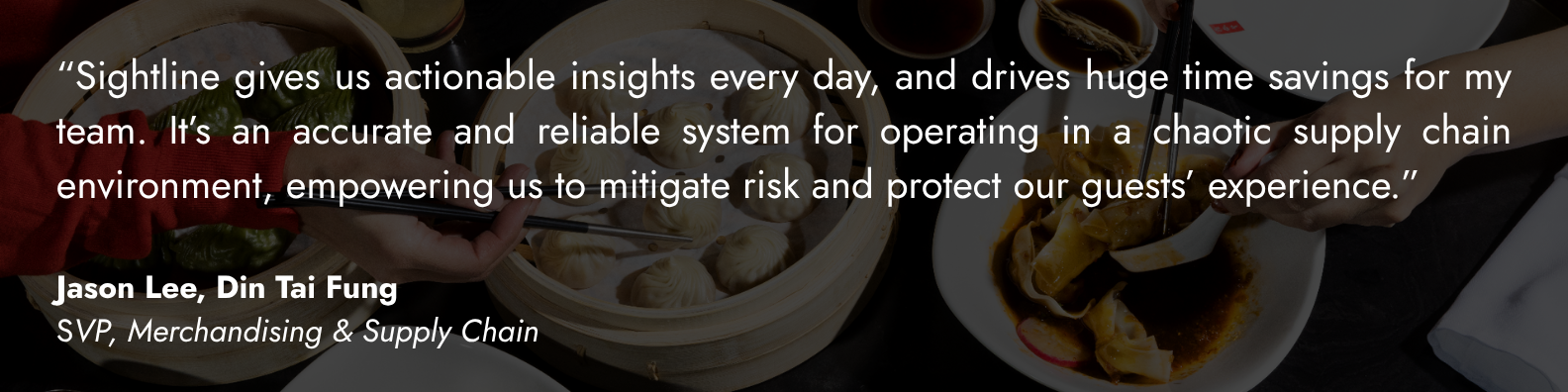
Din Tai Fung is one of the most recognized restaurant brands in the world — a globally distributed chain with exacting quality standards and a menu built around fresh, handcrafted products that have essentially no tolerance for ingredient substitution.
The supply chain challenge at Din Tai Fung is not just scale. It is precision. The signature Xiao Long Bao that guests expect in Taipei must be identical to the one served in Los Angeles or Sydney. That consistency starts with supply chain.
Din Tai Fung deployed machine learning-based demand forecasting to drive supply planning across its network — a use case that requires not just accurate location-level demand forecasts, but the ability to translate those forecasts into precise ingredient requirements and purchasing decisions. The results were measurable and meaningful: a 14% improvement in forecast accuracy, a 25% reduction in out-of-stocks on critical SKUs, and a 99.7% fill rate across proprietary products.
When Din Tai Fung navigated a significant distributor transition, the same forecasting infrastructure proved its value in a different context — providing the visibility needed to manage the transition without service disruption, and the data to hold both the outgoing and incoming distributor accountable during the handoff period.
The Metrics That Matter
Best-in-class multi-unit supply chain teams measure differently from average teams. They track leading indicators, not just lagging ones. They monitor at daily and location-level granularity, not just weekly and system-wide. And they use their metrics to drive conversations, not just to document what happened.
The metrics that matter most to leading teams include:
Fill rate by DC and by supplier, tracked daily against target
Forecast accuracy at the item-location level, measured weekly
Inventory days on hand by category and by location
Emergency order rate and cost premium, tracked as a leading indicator of forecast quality
COGS variance versus contract pricing, monitored by distributor and by category
12-week demand signal confidence, reviewed in weekly planning meetings
SECTION 5
What's Next: Building a Supply Chain That Scales
The picture painted in Section 4 is not aspirational. It is operational, today, for the chains that have made the right investments. This section is about how to get there — the investments that matter most, the decisions that are hardest to get right, and the practical roadmap for supply chain modernization in 2026.
The Investments That Matter Most:
-
The highest-leverage investment most multi-unit restaurant supply chain teams can make is not in technology. It is in the people who will use that technology to make better decisions. This means hiring people who are comfortable with data and capable of translating it into operational insight. It means developing supply chain leaders who can hold strategic conversations with finance, operations, and the C-suite. And it means protecting those people from the firefighting trap — giving them the tools and infrastructure that allow them to do strategic work rather than reactive work.
-
With the right people and the right data infrastructure in place, the investment in intelligent tooling delivers compounding returns. ML-based demand forecasting, automated exception management, real-time visibility dashboards, and commodity intelligence tools each add value individually. Together, they create a supply chain operating system that is qualitatively more capable than any of its parts.
How to Evaluate Supply Chain Technology for Enterprise Restaurant Operations
The technology landscape for supply chain — and for an enterprise forecasting system for restaurants specifically — is opaque. Vendors make claims that are difficult to validate without significant investment of time and resources.
Does this tool work with the data sources we actually have, or does it require data infrastructure we don't yet have?
What is the implementation timeline, and what does the team have to do to get there?
How does the tool handle the specific complexity of restaurant supply chains — perishables, LTOs, distributor relationships, multi-unit variance?
How will this tool support growth in new markets and drive efficiencies at scale?
What does ongoing support look like, and who owns the relationship after implementation?
Can we see evidence of performance in a restaurant supply chain that is comparable in size and complexity to ours?
The red flags to watch for: vendors who cannot produce reference customers in your segment, implementation timelines measured in years rather than months, tools that require you to change your processes to fit their software rather than the reverse, and claims of AI capability that cannot be explained in plain operational terms.
The Build vs. Buy vs. Modernize Decision
The question of whether to build supply chain technology internally, buy a purpose-built solution, or layer modern tooling on top of existing systems is one of the most consequential decisions a supply chain leadership team makes. It deserves more rigorous analysis than it typically receives.
Build is almost never the right answer for supply chain forecasting and planning tools. The engineering investment required to build and maintain machine learning forecasting infrastructure is substantial, the resulting product is not customer-facing, and the core competency of a restaurant chain is not software engineering. The exception is when the supply chain has genuinely unique characteristics that no available solution addresses.
Buy makes sense when a purpose-built solution exists that fits your requirements, your data infrastructure is ready to integrate with it, and the vendor has demonstrated performance in comparable environments. The risk is vendor dependency and the loss of flexibility to adapt as your needs change.
Modernize — layering intelligent tooling on top of existing ERP and distributor systems — is often the most practical path for multi-unit restaurants. It preserves existing system investments, reduces implementation risk, and can deliver meaningful value faster than a full platform replacement. The key is choosing tools that integrate cleanly with existing infrastructure rather than requiring parallel systems.
Making the Business Case Internally
The supply chain leader who wants to invest in better tooling faces a common challenge: the C-suite and the finance team did not experience the supply chain problem firsthand, and they are being asked to authorize investment to solve it.
The most effective business cases share three characteristics. First, they quantify the current cost of the status quo — the emergency order premiums, the out-of-stock revenue impact, the manual labor hours that could be redirected, the COGS leakage from invoice compliance gaps. Second, they project the specific value of the improvement — not in abstract efficiency terms, but in the financial outcomes that the finance team cares about: COGS reduction, labor productivity, revenue protection. Third, they anchor the investment in a specific, time-bounded outcome: 'Within 12 months, we will reduce emergency order costs by X% and improve fill rates to Y%.
The supply chain investment case that wins is not the one that describes the technology most compellingly. It is the one that speaks most clearly to the financial outcomes that leadership is already focused on.
CONCLUSION
The Opportunity in Front of You
The multi-unit restaurant supply chain is at an inflection point. The tools, the data, and the organizational models that define best-in-class performance have never been more accessible. The gap between what is possible and what most teams are experiencing has never been more apparent. And the competitive consequence of being on the wrong side of that gap has never been more significant.
The chains that are winning today did not get there by waiting for the perfect moment to invest. They made deliberate decisions, sequenced correctly, built the data infrastructure, hired the right people, and deployed the tooling that turned supply chain from a reactive function into a proactive competitive advantage. The results are measurable: lower COGS, better fill rates, fewer out-of-stocks, stronger distributor relationships, and supply chain teams that are retained rather than burned out.
The gap between leaders and laggards is widening faster than at any point in recent memory. The chains at the top are compounding their advantage every quarter. The chains that delay are not standing still — they are falling further behind.
The question is not whether to invest in supply chain capability. The question is how quickly you can move.
The best time to build a proactive supply chain was five years ago. The second best time is now.
If you're ready to see what a modern supply chain intelligence platform looks like in practice — and what it could mean for your specific operation — the Sightline team would welcome the conversation.
APPENDIX
Glossary of Key Supply Chain Terms for Restaurant Operators
Fill Rate — The percentage of ordered items that are delivered in full and on time by a distributor or supplier. A fill rate of 95% means 5% of ordered items were not delivered as expected.
Forecast Accuracy — A measure of how closely a demand forecast matches actual demand. Typically expressed as a percentage, where 100% represents a perfect forecast.
Days on Hand (DOH) — The number of days of inventory currently on hand at a location or distribution center, based on current demand rates.
Emergency Order — An order placed outside of the standard ordering cadence, typically to address a shortage or out-of-stock situation. Emergency orders typically carry significant cost premiums.
LTO (Limited Time Offer) — A menu item or promotion available for a defined period. LTOs create significant supply chain planning challenges due to demand uncertainty and supply lead time requirements.
ML (Machine Learning) — A form of artificial intelligence in which models learn from historical data to make predictions, rather than following explicitly programmed rules. In supply chain contexts, ML models are used for demand forecasting, anomaly detection, and optimization.
Out-of-Stock (OOS) — A condition in which a menu item is unavailable at a location due to insufficient inventory. Out-of-stock events directly affect guest experience and revenue.
COGS (Cost of Goods Sold) — The direct costs associated with producing the menu items sold by a restaurant, including food ingredients and supplies.
Broadline Distributor — A distributor that carries a wide range of food and non-food products across multiple categories, serving as a primary supplier to many restaurant chains.
DC (Distribution Center) — A warehouse facility operated by a distributor that receives products from suppliers and distributes them to restaurant locations within a defined geography.
