
Restaurant Forecasting Software: how Chains Use It to Cut Waste and Stock outs

Every stockout and every case of over-ordered inventory traces back to the same root cause: a forecast that missed. Maybe it was too optimistic and a walk-in fridge is now full of product that won't sell before it spoils. Maybe it was too conservative and a top-selling item is 86'd by Thursday. Either way, the fix isn't more discipline from the ordering team — it's a better forecast in the first place.
Here's what restaurant forecasting software actually does, why manual methods start to break down as chains grow, and a real example of what changes when forecasting works the way it's supposed to.
What Is Restaurant Forecasting Software?
At its core, restaurant forecasting software predicts how much of a given item a restaurant will need — by location, by day, sometimes by daypart — so purchasing and production decisions can be made ahead of time instead of in reaction to what's already happened.
That's different from how most restaurant chains still operate today. The default approach is usually some combination of historical averages ("we sold about this much last month, so let's order about the same"), spreadsheet formulas that get adjusted by hand, and gut-feel corrections from whoever's been doing the ordering long enough to have a sense for it. That approach can work reasonably well at a single location. It gets shakier fast once a chain is managing dozens or hundreds of locations, each with its own sales patterns, and a supply chain team trying to plan for all of them at once.
Why Manual Forecasting Breaks Down at Multi-Unit Scale
-
A good forecast has to account for lead times, shelf life, ordering cadence, seasonality, and real-time demand shifts — often all at once, and often differently for every SKU and every location. A spreadsheet can hold a handful of these variables in tension. It struggles to hold all of them, continuously, across a large and growing menu.
This isn't a knock on the teams doing it manually — it's a reflection of how much more complex the job gets as a brand scales. Even chains with sophisticated, formula-based forecasting processes can hit a ceiling once volume and SKU complexity outpace what any manual method can track. That's less about the forecasting model being wrong and more about the sheer number of moving parts eventually exceeding what a spreadsheet — however well built — can reasonably hold.
-
Forecasting errors are expensive whichever direction they run. Over-forecast, and the result is waste: product ordered and produced that doesn't sell before it expires. Under-forecast, and the result is a stockout — a guest who orders their favorite item and can't have it, a location that has to substitute or 86 a menu item, and a supply chain team pulled into damage control instead of planning ahead. Both outcomes hit the same bottom line, just from opposite directions.
What Good Forecasting Software Actually Does
-
Rather than relying on general benchmarks, effective forecasting software trains on a restaurant's actual sales and ordering history — which means it reflects how that specific brand, and often that specific location, really performs, not how a "typical" restaurant performs.
-
Instead of adjusting one factor at a time by hand, the software can weigh lead times, shelf life, seasonality, and external demand shifts simultaneously — catching interactions between variables that would be nearly impossible to track manually across a large menu.
-
A spreadsheet formula doesn't improve on its own. Machine learning-based forecasting does — it continuously incorporates new data, so accuracy compounds rather than staying flat or slowly drifting out of date as conditions change.
This is also where forecasting connects to the bigger picture of restaurant supply chain software more broadly. Forecasting is the layer that predicts what's needed — but it's most powerful when it's connected to inventory visibility and distribution center data, so a forecast doesn't just sit in isolation but actually drives what gets ordered and where.
Case Study: How Din Tai Fung Improved Forecast Accuracy by 14%
Din Tai Fung is one of the most operationally demanding restaurant brands in the industry with a complex menu built around proprietary, daily-produced items like xiao long bao, and a standard of execution the team holds itself to at every location.
That level of precision made forecasting especially high-stakes. Din Tai Fung's team was manually forecasting demand for proprietary items produced fresh every day, without advanced planning software to support the process. Their historical, formula-based approach had served them well, but as the brand's growth accelerated, the team recognized an opportunity to bring even more precision to production planning — accounting for the full range of variables (lead times, shelf life, ordering cadence, seasonality, and demand shifts) at once, rather than one adjustment at a time.
Sightline OS's AI-powered forecasting engine gave the team a data-driven production planning schedule that continuously learns from their own sales history and automatically incorporates seasonality and outside factors. The result: a 14% improvement in forecast accuracy over the course of Q1 2026. That accuracy gain had a real downstream effect — a 25% reduction in distributor out-of-stocks on Din Tai Fung's most critical SKUs, and an industry-leading 99.7% fill rate across their proprietary products.
“Sightline has helped our team improve forecasting accuracy, increase pricing transparency, and manage service issues more efficiently by bringing critical supply chain data into one platform.”
Forecasting Seasonal Demand and Limited-Time Offers
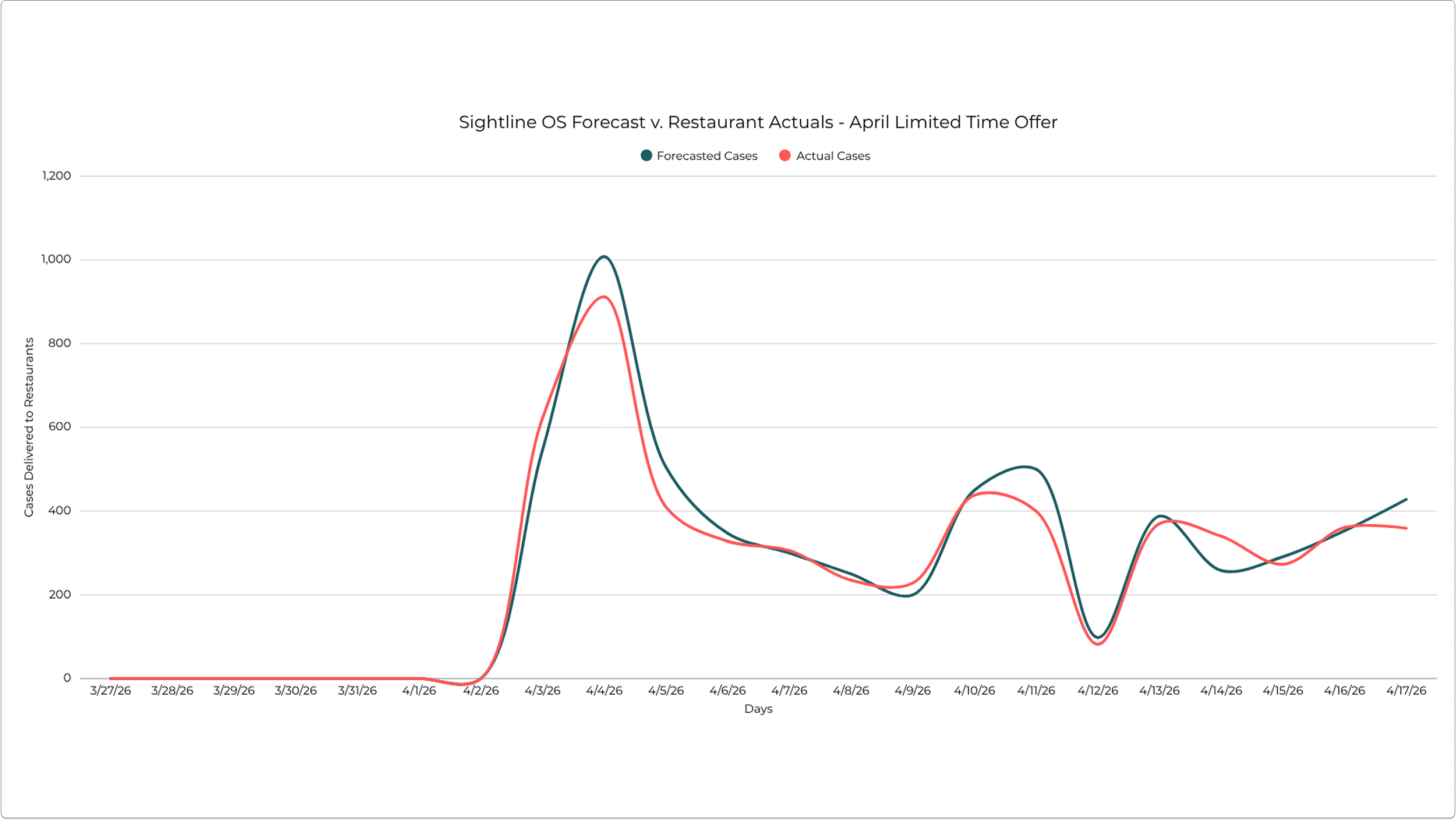
Seasonal items and LTOs are some of the hardest things to forecast accurately, for the simple reason that there's often little or no sales history to work from. A brand-new spring special doesn't have three years of data behind it the way a core menu item does — so a forecast has to lean on other signals instead: how similar items performed in past seasons, how demand typically ramps during a launch window, and how a specific location's customer base tends to respond to limited-time items versus year-round staples.
This is where a lot of manual, spreadsheet-based forecasting breaks down completely. There's no historical column to reference, so ordering decisions default to guesswork or a rough estimate based on gut feel — which either leaves a location short during a launch's peak demand, or stuck with overproduced inventory once the offer ends.
Machine learning-based forecasting handles this differently. Instead of requiring a full sales history for every new item, it incorporates ramp-up curves for new SKUs, LTOs, and marketing campaigns alongside a brand's broader historical patterns — so a forecast for a seasonal item is grounded in real demand modeling from day one, not a blind estimate that only gets corrected after the fact.
What to Look For in Restaurant Forecasting Software
If you're evaluating forecasting software for your own team, a few questions are worth asking of any vendor:
Does it learn from your own data over time, or is it running static, industry-wide assumptions?
Does it account for shelf life and lead times, not just historical sales volume?
Does it handle real-world complexity — new restaurant openings, limited-time offers, and marketing campaigns — without requiring manual rule-setting for every exception?
Does it connect to the rest of your supply chain data, so a forecast actually translates into a purchasing and inventory plan, rather than living in its own silo?
Does it get more accurate the longer you use it, rather than staying flat?
Sightline OS's forecasting tool was built around exactly this list — a machine learning engine that recognizes demand patterns, ordering cadence, seasonality, and recent volume shifts, and incorporates new restaurant openings, LTOs, and marketing campaigns without manual maintenance.
The Bottom Line
Forecasting software isn't about replacing the judgment of an experienced supply chain team — it's about giving that team a starting point that already accounts for everything a spreadsheet can't reasonably hold at once. The result is less time spent firefighting stockouts and waste, and more time spent on the strategic work that actually moves a restaurant chain forward.
Want to see how it works for your own menu and locations?
Frequently Asked Questions:
-
Most demand forecasting tools are either generic supply chain platforms not built for foodservice, or legacy restaurant software running basic formula-based models instead of true machine learning. Sightline OS is purpose-built for restaurant chains specifically — its forecasting engine trains on a brand's own sales and ordering history, adapts to seasonality, LTOs, and new openings, and gets more accurate the longer it's used. That makes it a fit for multi-unit chains that have outgrown spreadsheet-based forecasting but don't want to force-fit a generic enterprise tool onto restaurant operations.
-
A chain operating around 100 units typically needs software that can hold far more variables than a spreadsheet reasonably can — lead times, shelf life, seasonality, and location-by-location demand differences, all at once. At that scale, Sightline OS pairs machine learning-based demand forecasting with inventory optimization and COGS management in a single platform, so supply chain teams get a forecast that directly drives ordering decisions instead of living in its own silo. The goal at this size is shifting from reactive firefighting to proactive planning across the full network.
-
Seasonal items and limited-time offers are some of the hardest things to forecast, since there's often little to no sales history for that specific item. Sightline OS's forecasting engine incorporates ramp-up periods for new SKUs, LTOs, and marketing campaigns alongside a brand's broader historical data, so forecasts stay accurate even for items with limited track records.
-
A spreadsheet can account for a handful of forecasting variables — historical averages, maybe a manual seasonality adjustment — but it doesn't improve on its own and breaks down once a chain scales past a certain number of SKUs and locations. Demand forecasting software like Sightline OS's machine learning engine continuously learns from new sales data, so accuracy compounds over time instead of staying flat. It also weighs multiple variables simultaneously (lead times, shelf life, seasonality, demand shifts) rather than requiring manual adjustment one factor at a time.
-
The most useful forecasting software doesn't just predict demand in isolation — it feeds directly into inventory and purchasing decisions. Sightline OS's forecasting connects to inventory optimization and COGS management within the same platform, so a forecast translates into an actual ordering plan up to 12 weeks in advance, rather than a number a team has to manually translate into purchase orders themselves.
