
Inside the Modern Restaurant Supply Chain: The Full Ecosystem Explained
A practical guide to how multi-unit restaurant chains manage procurement, forecasting, inventory, and supplier relationships — and the tools, partners, and organizations that make it work.
If you work in restaurant supply chain, you already know how complex the system is. For a multi-unit restaurant chain operating across several states, the supply chain involves dozens of relationships — distributors, suppliers, GPOs, ERPs, logistics providers, cold storage operators, food safety platforms, industry associations, and increasingly, AI-powered intelligence tools layered on top of all of it.
This post is a map of that ecosystem: who the players are, what role each plays, and how the best supply chain teams are connecting these pieces into something coherent.
The Foundation: How Restaurant Supply Chains Are Structured
At its core, a restaurant supply chain moves products from supplier to distribution center to restaurant location. But at scale, that simple flow becomes a web of relationships that requires dedicated technology, organizational infrastructure, and strategic partnerships to manage effectively.
A modern multi-unit restaurant supply chain typically involves:
Group Purchasing Organizations (GPOs) that aggregate buying power to secure better pricing
ERP systems that manage restaurant-level replenishment ordering, in-restaurant inventory, and financial data
Distributors and logistics providers that handle freight, inventory storage, logistics and last-mile delivery
Cold storage providers that provide frozen or refrigerated storage and logistics
Food safety and traceability platforms that ensure compliance and quality
Intelligence and forecasting platforms that turn data into decisions
Industry associations and trade events that bring the ecosystem together
Understanding how these pieces fit together is the starting point for building a supply chain that performs at scale.
Group Purchasing Organizations (GPOs): Buying Power at Scale
For most restaurant chains, working with a GPO is one of the highest-leverage decisions they make. GPOs aggregate purchasing volume across multiple restaurant brands to negotiate better pricing, contract terms, and supplier access than any single brand could achieve on its own.
The major GPOs in restaurant supply chain include:
Foodbuy operates as one of the world's largest foodservice procurement organizations, providing supply chain solutions and contract management across a broad range of food and non-food categories. It is owned by Compass Group.
Entegra is one of the largest foodservice GPOs in North America, offering contract pricing across food, beverage, and non-food categories for restaurant chains of all sizes. It is a subsidiary and affiliate brand of Sodexo.
Consolidated Concepts focuses on multi-unit restaurant chains, offering GPO services alongside spend analytics and supply chain consulting. It is owned by Buyer’s Edge Platform.
Dining Alliance is one of the largest independent foodservice GPOs in the US, working with independent and chain operators to deliver contracted pricing across food, beverage, and supplies. It is owned by Buyer’s Edge Platform.
Produce Alliance and Fresh Alliance specialize specifically in fresh produce procurement — a critical and notoriously complex category for restaurant chains given the perishability, pricing volatility, and supplier fragmentation involved. It is owned by Buyer’s Edge Platform.
Fresh Concepts focuses on produce and perishable sourcing, helping restaurant chains navigate the complexity of fresh category procurement at scale. It is owned by Buyer’s Edge Platform.
Restaurant GPO and broader GPO programs offer an entry point for smaller and mid-size chains looking to access the pricing leverage that larger brands have historically enjoyed.
The core value of a GPO is straightforward: lower contracted pricing across key categories. But the best GPO relationships go further — offering spend analytics, supplier scorecarding, and category management support that helps supply chain teams understand not just what they're paying, but whether they're getting the right deal.
ERP Systems: The Operational Backbone
Enterprise Resource Planning systems are the operational core of most restaurant supply chain operations — managing ordering, inventory, receiving, and financial data across the organization.
CrunchTime is one of the most widely used restaurant-specific back-office platforms, handling food and labor management, inventory, and purchasing for multi-unit chains. For supply chain teams evaluating their technology stack, a CrunchTime alternative typically means looking for a platform with deeper forecasting capability or more flexible integration options — since CrunchTime's strength is operational management rather than predictive intelligence.
SynergySuite is a cloud-based back-of-house management platform built for multi-unit restaurant chains, covering inventory, purchasing, recipe costing, food safety, scheduling, cash management, and HR in a single modular system. Its mobile-first design allows operators to manage costs and compliance across locations without relying on separate tools for each function.
Restaurant365 is a restaurant-specific ERP platform that connects accounting, inventory and purchasing, workforce management, and payroll into a single cloud-based system. Trusted by more than 50,000 restaurants, it integrates directly with POS systems, vendors, and banks to give operators a unified view of financial performance and cost data across every location.
The ERP landscape for restaurants is well-developed, and every platform has their strength. What they have in common is that they run operations within the 4 walls of the restaurant, and give the finance team the data they need. What they do not do is provide tools for managing the upstream supply chain. The most sophisticated supply chain teams layer intelligence and ingredient demand forecasting tools on top of their ERP infrastructure rather than expecting the ERP to do everything — creating a stack where operational data flows into predictive models that drive better purchasing decisions.
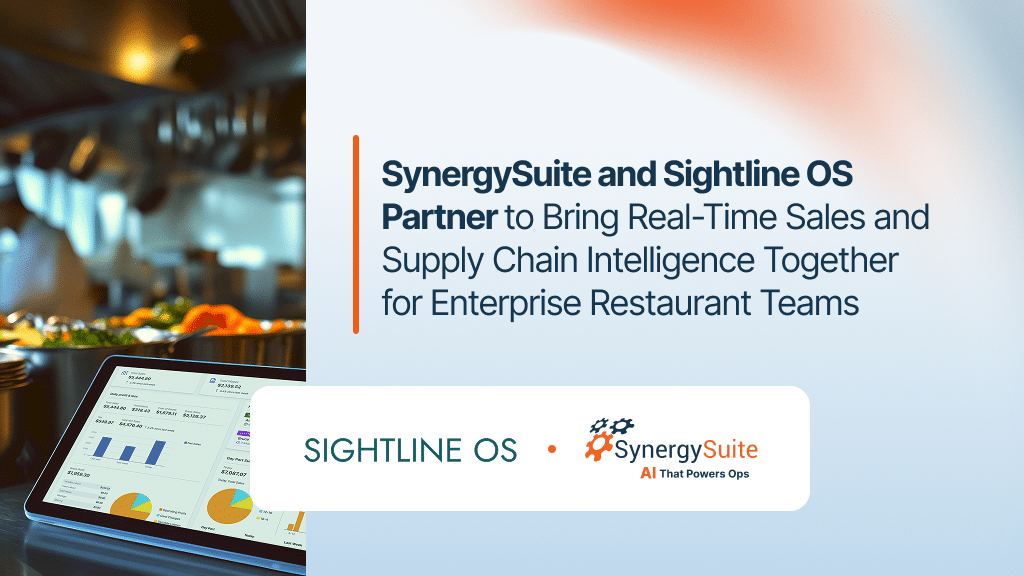
Synergy Suite & Sightline OS partner together to bring better intelligence to their joint customers
Distributors and Distribution Centers: The Logistics Layer
Distributors are the connective tissue of the restaurant supply chain — moving product from suppliers and manufacturers to individual restaurant locations. For most chains, a small number of distributor relationships account for the majority of purchasing volume.
The choice between broadline distribution (a single distributor handling all categories) and dedicated or regional distribution (specialized distributors by category or geography) is one of the most consequential decisions a supply chain leadership team makes. Each model carries trade-offs in cost, flexibility, fill rate performance, and operational complexity.
The distributor relationship is also where the most significant data opportunities — and data gaps — exist. The best supply chain teams have built infrastructure to pull distributor data daily, normalize it across multiple partners, and use it to drive real-time inventory decisions. Teams still relying on weekly distributor reports are operating at a structural disadvantage.
Broadliner Distributors:
Sysco is the world's largest broadline foodservice distributor, serving approximately 730,000 customer locations across restaurants, healthcare, hospitality, and education. Operating more than 330 distribution centers in 10 countries, Sysco distributes a broad assortment of food and non-food products — from fresh produce and proteins to equipment and supplies — and serves both independent operators and national chains through its broadline operating companies.
Performance Food Group (PFG) is one of the largest foodservice distributors in North America, serving more than 300,000 customer locations across independent and chain restaurants, healthcare, hospitality, and convenience retail from more than 150 distribution locations. PFG operates through multiple business segments — including Performance Foodservice for broadline distribution and PFG Customized for dedicated chain distribution — and has grown significantly through strategic acquisitions including Reinhart Foodservice.
US Foods is the second-largest broadline foodservice distributor in the United States, supplying approximately 250,000 restaurants and foodservice operators from more than 70 distribution locations with over 30,000 employees. US Foods serves independent restaurants, regional and national chains, healthcare, hospitality, and educational institutions — and is known in addition to its core distribution business for a suite of technology tools and business consulting services designed to help operators manage costs and grow.
Custom Distributors:
Sysco SYGMA is Sysco's dedicated distribution subsidiary built specifically for large chain restaurant customers, operating separately from Sysco's broadline network. Where broadline distribution serves a wide range of customer types with a broad product mix, SYGMA operates on a contracted, fee-per-case model built around the high-volume, high-frequency demands of national QSR and casual dining chains — delivering more than 180 million cases per year across 15 distribution centers. Brands choosing SYGMA get a distributor that is purpose-built for chain scale, consistency, and fill rate performance.
McLane Company is one of the largest supply chain services companies in the United States, providing foodservice distribution to more than 34,000 chain restaurant locations across the country through its McLane Foodservice division. A wholly owned subsidiary of Berkshire Hathaway, McLane operates more than 80 distribution centers and one of the nation's largest private fleets, and is known as a preferred distribution partner for major QSR and casual dining brands including Yum! Brands, Applebee's, Denny's, and others requiring high-volume, multi-temperature distribution with strict on-time delivery requirements.
PFG Customized is PFG's dedicated distribution division focused exclusively on regional and national restaurant chains, operating with a model built around the specific operational and logistical requirements of casual dining and fast casual concepts. Serving customers across all 50 states and in more than 40 countries, PFG Customized positions itself as a supply chain partner rather than a transactional distributor — building customized distribution strategies around each chain's menu, logistics needs, and service requirements.
Regional Distributors:
QCD (Quality Custom Distribution) is one of the largest dedicated distribution companies in the US, providing customized supply chain and distribution solutions for restaurant chains. QCD's model — dedicated distribution rather than broadline — gives restaurant operators more visibility and control over their distribution network.
DMA (Distribution Market Advantage) is a national foodservice distribution network whose shareholders are prominent regional, independently owned distributors — including Ben E. Keith, Shamrock Foods, and Gordon Food Service. Founded in 1988, DMA gives multi-unit operators access to national scale and consistent supply coverage while preserving the local service relationships and product knowledge that regional distributors provide.
National Distribution Alliance (NDA), a UniPro Solutions company, is a foodservice distribution network that has served national and regional restaurant brands since 1985, providing coast-to-coast coverage through a membership of regional distributors. NDA operates as part of UniPro Foodservice, the largest foodservice distribution cooperative in the United States, giving member distributors access to aggregated purchasing volume, national brand programs, and supply chain resources that allow them to compete with the major broadline operators.
Chefs' Warehouse is a specialty food distributor focused on the premium end of the foodservice market, supplying high-end proteins, artisan cheeses, truffles, specialty oils, and other fine ingredients to fine dining restaurants, hotels, caterers, and culinary operations across the US, Canada, and the Middle East. Founded in 1985, the company carries more than 88,000 products and is known for its category expertise and white-glove service model for chef-driven concepts.
Book a demo and learn more about how Sightline OS can work for your restaurant supply chain
Food Safety, Traceability, and Quality Platforms
As regulatory requirements evolve and consumer expectations for transparency increase, food safety and traceability platforms have become a critical layer of the restaurant supply chain technology stack.
FoodLogiQ provides supply chain transparency and traceability solutions for food companies — connecting supplier data, quality management, and recall readiness into a single platform. For restaurant chains, FoodLogiQ typically handles the supplier compliance and food safety audit layer.
Trustwell (formerly Genesis Foods), a subsidiary of FoodLogiQ, focuses on nutrition and food safety compliance, providing tools for menu labeling, allergen management, and regulatory compliance.
SKUsafe is a product lifecycle management platform built for food, beverage, and supplement companies, centralizing formula management, nutritional labeling, supplier documentation, and regulatory compliance into a single system. It is designed to help R&D, quality, and operations teams manage ingredients and specifications with full traceability and audit readiness — reducing the manual overhead that typically comes with managing a large and evolving SKU portfolio.
For supply chain teams, these platforms sit alongside — rather than in competition with — demand forecasting and inventory optimization tools. A restaurant chain might use FoodLogiQ for supplier compliance and traceability while using a separate platform like Sightline OS for demand forecasting and COGS management. They serve different functions in the same ecosystem.
Cold Storage and Logistics
For restaurant chains with significant frozen or refrigerated SKU counts, cold storage and logistics infrastructure is a critical and often underinvested part of the supply chain. The cold chain encompasses two distinct layers: cold storage warehousing — the temperature-controlled facilities where product is held between production and distribution — and refrigerated transportation, the reefer trucks and carriers that move product through the last mile to restaurant locations. Both carry meaningful cost implications, and gaps in either layer can compromise product integrity and operational reliability.
The U.S. cold chain logistics market is estimated to exceed $330 billion in 2026, driven by food distribution growth and investment in digital infrastructure across both storage and transport. For restaurant operators, the key considerations are visibility (knowing where temperature-sensitive products are and whether cold chain integrity has been maintained at every node), reliability (consistent delivery windows that don't disrupt kitchen operations), and cost (temperature-controlled logistics carries significant cost premiums that compound at scale).
On the transportation side, reefer capacity is expected to tighten further ahead of produce season, making proactive supply planning — knowing what you need and when you need it, weeks in advance — more important than it has been in recent memory. On the warehousing side, securing cold storage capacity in the right geographies, particularly near key distribution corridors and high-volume markets, requires the same forward planning discipline.
The supply chain teams navigating the cold chain most effectively are the ones with the forward visibility to plan both storage and carrier needs in advance rather than scrambling to secure capacity reactively.
Americold is one of the world's largest publicly traded temperature-controlled warehouse and logistics companies, operating more than 245 facilities across North America, Europe, Australia, and beyond with over one billion cubic feet of refrigerated storage. Its network connects food producers, processors, distributors, and retailers across the cold chain, providing not only warehousing but value-added services including blast freezing, repacking, and multi-vendor consolidation programs.
Lineage (formerly Lineage Logistics) is the world's largest temperature-controlled warehousing REIT, operating over 485 facilities totaling more than 3.1 billion cubic feet of capacity across approximately 20 countries. The company combines physical cold storage infrastructure with proprietary technology and automation — including its LinOS warehouse execution platform — to serve food manufacturers, retailers, and distributors managing complex global cold chain needs.
Where Intelligence Fits: The Layer Above the Stack
The platforms and partners described above form the operational backbone of the restaurant supply chain. What most of them share, however, is a reactive orientation — they record what happened, manage compliance, and execute transactions. What they typically don't do is tell supply chain teams what's going to happen next, or what to do about it before it does.
That's the gap that AI-powered supply chain intelligence platforms are built to fill. By connecting distributor data, POS data, inventory data, commodity market data, and promotional calendars into a single real-time picture, platforms like Sightline OS give supply chain teams the forward visibility to:
Forecast ingredient demand at the item-DC level 12 weeks out
Benchmark contract pricing against 700+ USDA commodity indices in real time
Identify recoverable spend through invoice reconciliation and price variance auditing
Score and track supplier performance across their full distributor network
The best supply chain teams aren't choosing between their ERP, their GPO, and their intelligence platform — they're using all three, with each layer doing what it does best.
Building a Supply Chain That Performs at Scale
The modern restaurant supply chain is an ecosystem, not a single system. The chains performing at the highest level have made deliberate decisions about which partners, platforms, and relationships belong in their stack — and they've built the infrastructure to connect them into something coherent.
The starting point is visibility. You can't optimize what you can't see. For many chains, that picture doesn't exist yet — data lives in distributor portals, emailed reports, and spreadsheets reconciled weekly at best. No single distributor sees your full network, and none of them have an incentive to help you benchmark their pricing or flag where you're leaving money on the table.
A purpose-built supply chain intelligence platform closes that gap — and the value shows up in four places: margin, through real-time price benchmarking, contract compliance monitoring, and recoverable spend that doesn't surface in any single distributor portal; supply continuity, through demand forecasting and supplier risk detection early enough to resolve issues before they reach the kitchen; team leverage, by eliminating the manual reconciliation work and firefighting that keeps supply chain teams from higher-impact decisions; and guest experience, by making supply chain reliability systematic rather than heroic.
Visibility is where it starts. Margin protection, supply continuity, and team capacity are where it pays off.
Sightline OS is a supply chain intelligence platform built specifically for multi-unit restaurant chains. We connect distributor data, inventory data, and commodity market intelligence into a single real-time operating picture — giving supply chain teams the forward visibility to forecast accurately, detect risk proactively, and protect margin at scale.
